Japan Accelerates Battery Recycling to Build a New Rare Metals Supply Chain


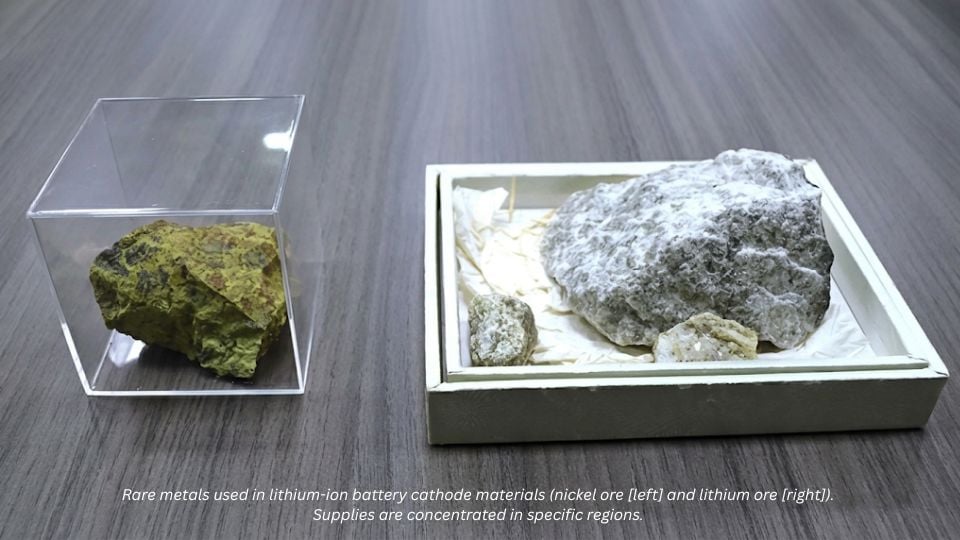
Japan’s storage battery recycling market is gaining momentum as overseas companies enter the sector and Japanese firms advance the development and commercialization of recycling technologies. With supplies of rare metals concentrated in specific regions, battery recycling is emerging as a way to recover valuable resources from “urban mines” and strengthen the resilience of the supply chain.
Shengte Plans ¥20 Billion Battery Recycling Plant in Japan
Taiwanese battery recycling company Shengte Materials is preparing to establish a back-end processing plant in Japan, with total investment expected to reach approximately ¥20 billion. The company is currently selecting a site in Shikoku, where many battery-related manufacturers have facilities, and aims to begin operations in fiscal year 2028.
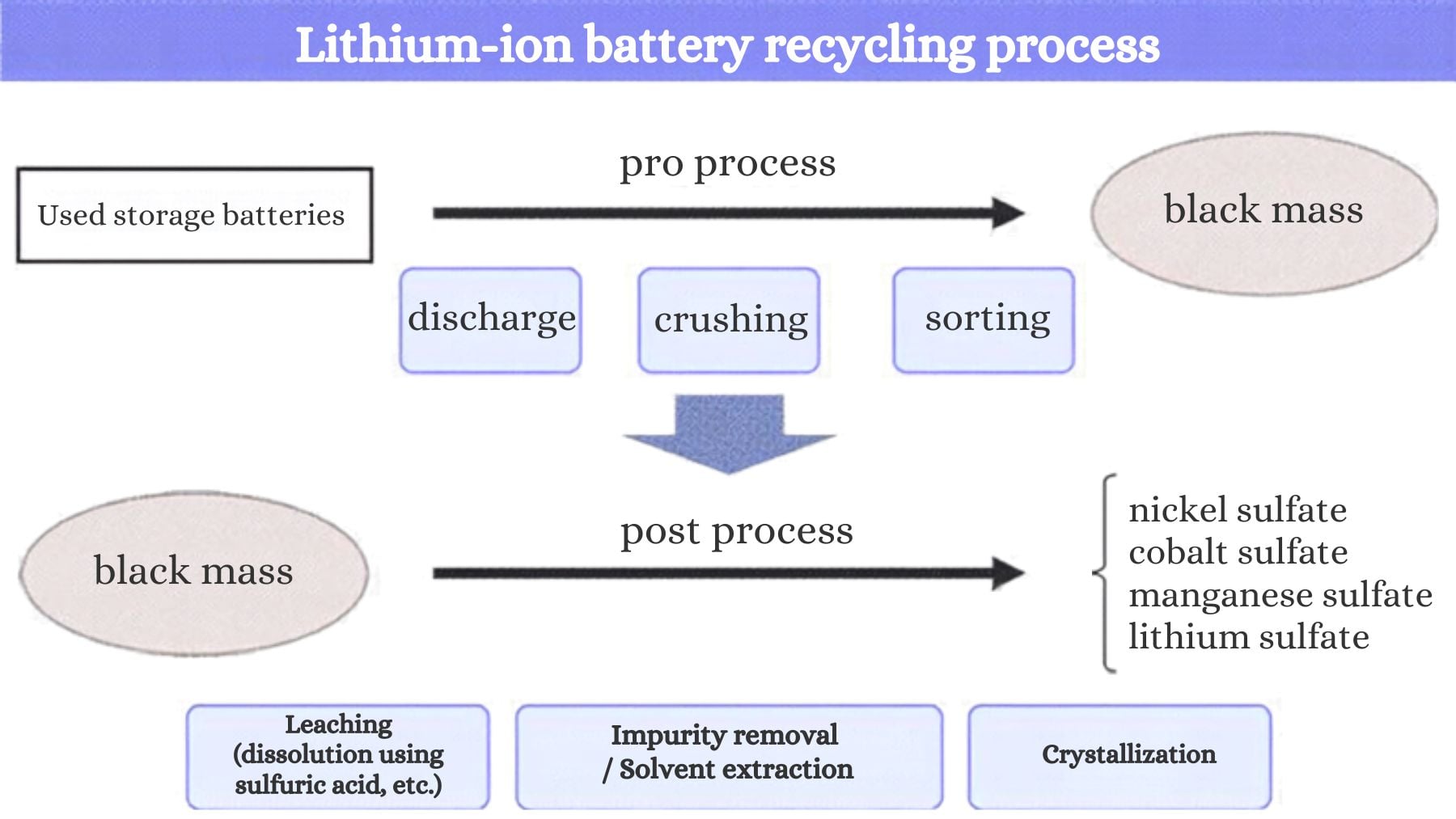
Shengte currently handles front-end processing at its plant in Taiwan, including rendering used lithium-ion batteries (LiBs) harmless and crushing them to produce black mass (BM). The planned Japanese facility will handle the subsequent refining process to recover rare metals such as nickel and cobalt.
The refining equipment will also be capable of processing Mixed Hydroxide Precipitate (MHP), a nickel-containing material derived from ore smelting. By using a common extraction system for both BM and MHP, Shengte expects to improve plant utilization and chemical efficiency.
Reusing Waste Sulfuric Acid to Reduce Environmental Impact
The new plant will also incorporate measures to reduce environmental impact. Shengte plans to establish systems to reuse sulfuric acid and water used in the hydrometallurgical refining process.
The company is also considering the use of waste sulfuric acid generated from semiconductor manufacturing at JASM, TSMC’s production subsidiary in Kikuyo, Kumamoto Prefecture.
At full capacity, the plant is expected to process raw materials equivalent to 3,600 tons of nickel per year. Estimated annual production capacity includes 23,000 tons of nickel sulfate, 2,300 tons of cobalt sulfate, 2,025 tons of manganese sulfate and 700 tons of lithium carbonate.
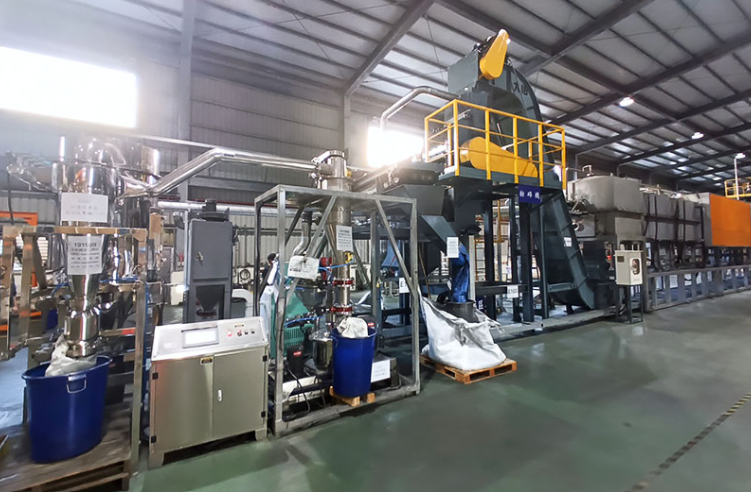
A production line at Shengte’s Taiwan plant for recovering black mass (BM) from used storage batteries.
Dry Process Enables High-Purity Black Mass Production
Shengte’s battery recycling operation also features proprietary dry-process discharge technology at its Taiwan plant. The company uses specialized equipment co-developed with a Japanese company, which has already been implemented on mass-production lines.
Compared with wet discharge processing, the dry process helps minimize contamination from hazardous substances and enables stable production of high-purity black mass.
The company’s Japanese subsidiary is leading development of the planned factory, with JBCT President Shohei Okashita describing the initiative as a contribution to economic security through “Made in JAPWAN” production, combining Japan and Taiwan.
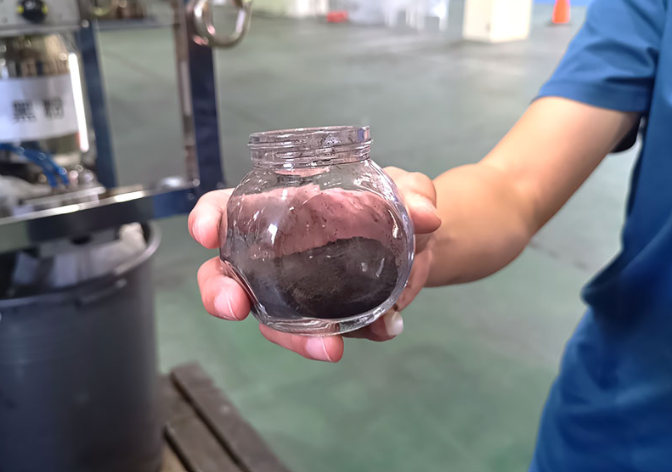
Black mass recovered by Batt. Cycle com. from used storage batteries
Japanese Companies Accelerate Battery Recycling Technology
Japanese companies are also moving forward with battery recycling technology development and commercialization.
Sumitomo Metal Mining and Kanto Denka Kogyo are developing technology to recover nickel, cobalt and lithium from used lithium-ion batteries. Their approach combines pyrometallurgy and hydrometallurgy to enable efficient processing even when batteries contain high levels of impurities.
Sumitomo Metal Mining plans to launch a commercial plant in Ehime Prefecture during fiscal year 2026. The plant is nearly complete and undergoing test runs, with the company targeting processing capacity of 10,000 tons per year, measured in terms of lithium-ion battery cell input, by fiscal year 2028.
Meanwhile, JERA and Sumitomo Chemical are jointly developing “direct recycling” technology for lithium-ion battery cathode materials. The process restores the structure of cathode materials rather than converting them back into metals. The companies aim to complete technology development by fiscal year 2030 and are considering a recycling business tailored to the electric vehicle recycling market.
⟶ Read more: Japan Targets 150 GWh Battery Manufacturing Base.
Battery Recycling Strengthens Rare Metals Supply Security
Establishing a battery recycling system is becoming increasingly important for strengthening the resilience of rare metals procurement amid supply uncertainty.
Junichi Tomono, an executive officer at Hanwa Kogyo, points out that strengthening the domestic battery supply chain is crucial in response to resource nationalism and geopolitical risks.
Battery recycling systems are also being developed in other markets. The European Union’s new battery regulations, which will begin applying in 2031, will require a minimum percentage of recycled materials in battery manufacturing.
In China, regulations requiring battery traceability and stronger corporate responsibility for EV battery recovery are driving further investment in recycling.
Japan, however, still has relatively few domestic operators capable of processing black mass. As a result, black mass produced by lithium-ion battery recyclers is reportedly being exported to South Korea, Southeast Asia and other regions.
The Japan Research Institute estimates that approximately 83% of used EVs from Japan were exported overseas by 2024. The value of rare metals contained in EV batteries that have flowed out of Japan since 2017 is estimated at approximately ¥17.5 billion.
Establishing domestic collection channels for used storage batteries and effectively utilizing these “urban mines” could therefore help retain valuable resources within Japan while strengthening economic security.