JIMTOF 2026 Highlights AI Advances in CNC Machining and Smart Manufacturing


Leading Japanese machine tool and CNC manufacturers are advancing AI applications to improve machining processes, reduce setup time and support troubleshooting. The developments also extend to Physical AI, enabling robots to perform tasks more autonomously as manufacturers seek to improve productivity and address skilled labor shortages.
November 3, 2026 – At JIMTOF 2026, Japanese machine tool and CNC manufacturers showcased how AI is being integrated into manufacturing operations. The applications range from machine condition analysis and machining optimization to setup assistance and troubleshooting—tasks that have traditionally depended heavily on experienced operators.
Okuma Develops AI Agent for Machine Diagnosis and Process Improvement
Okuma presented a prototype vertical machining center, the MB-46VEII, equipped with an AI agent. The system can diagnose and report machining results and machine conditions, while recommending process improvements and troubleshooting solutions. The company is targeting commercialization in fiscal year 2027.
A key feature is its integration with Okuma's Green Smart Machines, which use intelligent technologies to control machine operations. The AI agent draws on accumulated data from technologies such as the Thermo-Friendly Concept, which controls and suppresses thermal displacement, to provide machining recommendations aimed at improving productivity with fewer operators.
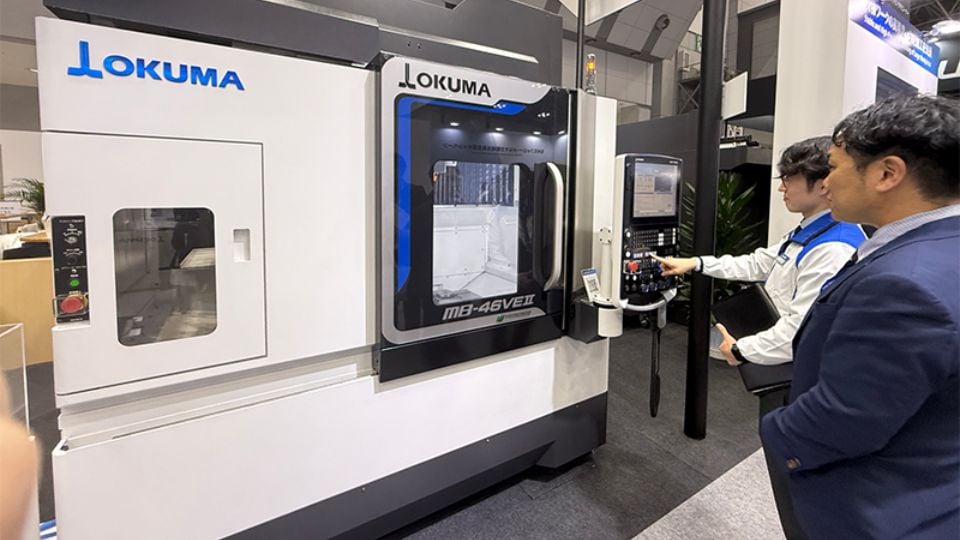
Okuma showcased the MB-46VEII vertical machining center equipped with an AI agent.
FANUC Introduces Physical AI CNC Concept and AI-Assisted Machining Optimization
FANUC unveiled its Physical AI CNC concept and MCP Server software, designed to help machine tool builders develop AI applications for advanced machining processes using FANUC CNC systems.
Machine tool manufacturers can incorporate their setup expertise and machining know-how into applications. When an operator enters a request, such as improving the machined surface, generative AI uses relevant CNC data and technical knowledge to suggest possible solutions.
If a recommendation involves changing CNC settings, the proposed changes can be tested through a digital twin connected to the CNC system. This allows users to evaluate the expected effects without conducting an actual test on the machine.
Yamazaki Mazak Applies AI Agents to Reduce Setup Time
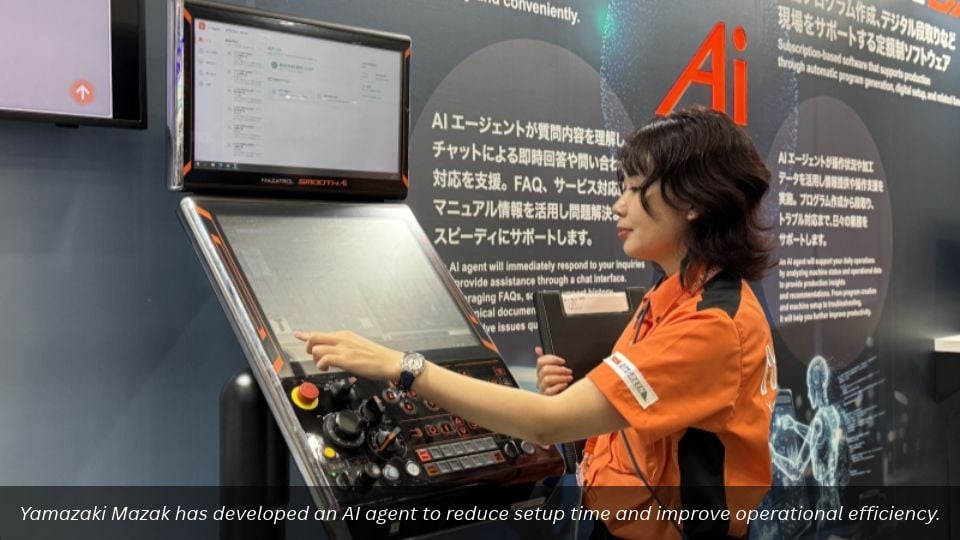
Yamazaki Mazak plans to integrate its independently developed AI agent into its cloud service, Mazak iConnect, and setup support software, Mazatrol DX.
For iConnect, the AI agent will provide immediate answers to user inquiries through a chat interface, helping users access service information more efficiently. In Mazatrol DX, it will assist with operational procedures, with the aim of shortening setup time and improving accuracy.
Mitsubishi Electric and DMG MORI Expand AI Support for Machine Operators
Mitsubishi Electric has developed an AI agent to make existing CNC machines easier to operate. It supports less experienced operators with pre-machining setup and helps identify possible causes of machine alarms—tasks that have traditionally relied on the experience and intuition of skilled workers.
The company also introduced a guide function connecting the AI agent with smart glasses. The system delivers machining-related instructions to operators through voice and text.
Meanwhile, DMG MORI introduced Service Agent, an AI-powered function that supports machine fault diagnosis and recommends solutions through its myDMGMORI customer portal.
The system has been trained using the repair experience of the company's MRO (Maintenance, Repair and Overhaul) engineers. When a machine fault occurs, it provides relevant checklists and possible responses based on the reported symptoms, helping users organize information such as alarm messages, occurrence timing and frequency.
FANUC Develops AI Vision for Autonomous Robot Operations
Beyond CNC applications, FANUC has developed AI Masterless Vision, a system that enables robots to recognize workpiece shapes and their surrounding environment using AI, then perform tasks autonomously. Shipments are scheduled to begin in January 2027.
For example, operators can issue natural-language instructions for a robot to load or unload a workpiece from a jig. The robot then recognizes its environment and carries out the task automatically.
The developments showcased at JIMTOF 2026 demonstrate how AI is becoming increasingly integrated into manufacturing—from machine setup and process optimization to troubleshooting and robot automation. These technologies are expected to play an important role in improving factory productivity and reducing dependence on highly specialized skills.
⟶ อ่านต่อ: Japan Machine Tool Orders Rise 64.7% in August 2026